
Our Head Gardener Answers Your Most Asked Rose Feeding Questions

Feeding your roses is probably one of the topics our Rosarians get asked about most and with an array of information online now, it is hard to know what the right approach is when it comes to feeding a rose.
Below, our Head Gardener and Rosarian Mat answers all of your questions about how we feed our roses here at Peter Beales.
When and how often should you feed your roses?
We recommend giving your roses a slow-release granular feed at the beginning of Spring each year, ideally in March, as the rose starts to leave its winter, dormant state.
Then our Rosarians recommend giving your rose another slow-release, granular feed after the first flush of blooms has gone over in July.
For best results, our Rosarians give their roses an extra boost by giving them a liquid feed every seven to ten days throughout the flowering season, in between slow-release granular feeds. This helps to encourage more healthy, abundant blooms throughout the summer
Why should you feed your roses?
Feeding your roses gives them the nutrients they need for strong growth, healthy foliage and more flowers. Well-fed roses are also more resistant to disease and pests and they tend to produce bigger, brighter blooms.
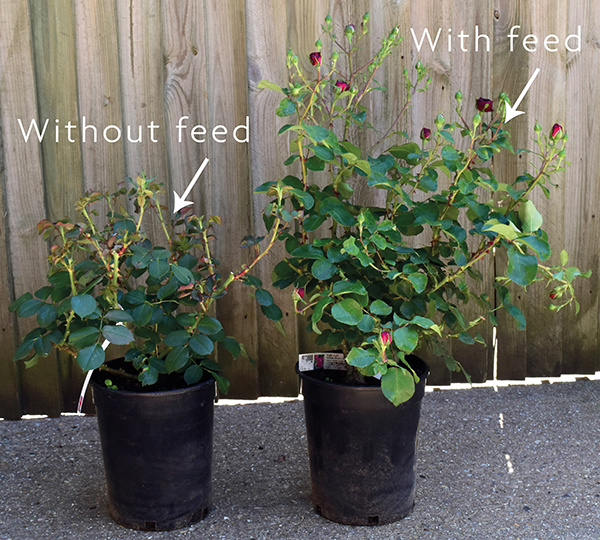
What is the difference between a slow-release granular rose feed and a liquid rose feed?
Slow-release granular rose feed is typically used twice a year and provides long-term nutrients to the soil, as it is slowly released over two to three months. As a result, this type of rose food benefits the long term health of the rose and the soil it is planted in, ensuring that the rose stays healthy for years to come.
In comparison, liquid feed is used on roses every seven to ten days throughout the flowering season and doesn’t stay in the soil for as long as a slow-release granular feed. It is a faster-acting feed that helps to encourage more blooms and give roses a boost that are stressed, unhealthy or suffering due to recent weather conditions.
How do you feed a rose?
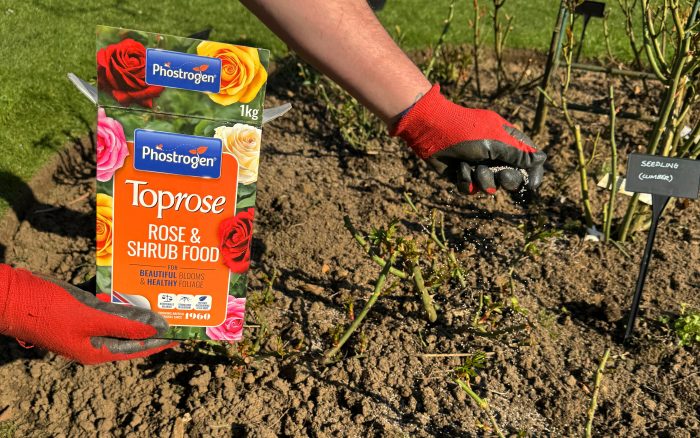
To feed your roses using a slow-release granular feed, clear the area around the base of the rose and then sprinkle the feed around the base of the plant, making sure not to get any on the leaves.
To feed your roses using a liquid feed, you can either water the base of the rose or spray the feed over the rose’s leaves. With liquid feed, you must dilute the feed with water, following the instructions on the back of the product so that you get the right concentration. Not diluting the feed enough can scorch the plant, doing more harm than good.
If you choose to spray your liquid feed, make sure you do it in the early morning or evening, when the sun is low, so that you don’t scorch the leaves.
What is the best rose food for my roses?
Our Rosarians recommend using Top Rose for your slow-release granular feed and Uncle Tom’s Rose Tonic or Tomorite for your liquid feed.
Can you overfeed a rose?
Our Rosarian’s would classify overfeeding a rose as feeding it more than once a week. Whilst it won’t do too much harm, you won’t see any extra benefits from feeding this frequently and it isn’t cost effective.
What is more of a concern regarding overfeeding a rose is not mixing the feed solution in the correct concentration. Doing this means there will be a chemical imbalance and your roses are likely to get scorched which may damage the foliage and roots of the plant.
Do roses in pots need feeding more than roses in the ground?
Despite popular belief, roses in pots don’t need feeding more than roses in the ground. Roses in pots need watering more frequently than roses in the ground due to the drainage in a pot, but feeding them more than recommended won’t produce any extra benefits.
Do newly planted roses need feeding more than established roses?
Newly planted roses don’t need feeding any more or less than established roses; they all need feeding the same amount. However, when planting a new rose, it is important to add some Toprose or mycorrhizal fungi into the hole and around the plant to give it the best chance of growth.
To learn more about planting a new rose, click here.
Want to learn more about feeding roses?
Or speak to one of our Rosarians for personalised advice
Comments are closed here.